

Mathematical Expected Value Worksheet Answer Key
What is Expected Value?
Expected value (also known as EV, expectation, average, or mean value) is a long-run average value of random variables. It also indicates the probability-weighted average of all possible values.

Expected value is a commonly used financial concept. In finance, it indicates the anticipated value of an investment in the future. By determining the probabilities of possible scenarios, one can determine the EV of the scenarios. The concept is frequently used with multivariate models and scenario analysis Scenario Analysis Scenario analysis is a process of examining and evaluating possible events or scenarios that could take place in the future and predicting the . It is directly related to the concept of expected return Expected Return The expected return on an investment is the expected value of the probability distribution of possible returns it can provide to investors. The return on the investment is an unknown variable that has different values associated with different probabilities. .
Formula for Expected Value
The first variation of the expected value formula is the EV of one event repeated several times (think about tossing a coin). In such a case, the EV can be found using the following formula:

Where:
- EV – the expected value
- P(X) – the probability of the event
- n – the number of the repetitions of the event
However, in finance, many problems related to the expected value involve multiple events. In such a scenario, the EV is the probability-weighted average of all possible events. Therefore, the general formula to find the EV for multiple events is:

Where:
- EV – the expected value
- P(XI) – the probability of the event
- X I– the event
Example of Expected Value (Multiple Events)
You are a financial analyst Financial Analyst Job Description The financial analyst job description below gives a typical example of all the skills, education, and experience required to be hired for an analyst job at a bank, institution, or corporation. Perform financial forecasting, reporting, and operational metrics tracking, analyze financial data, create financial models in a development company. Your manager just asked you to assess the viability of future development projects and select the most promising one. According to estimates, Project A, upon completion, shows a probability of 0.4 to achieve a value of $2 million and a probability of 0.6 to achieve a value of $500,000. Project B shows a probability of 0.3 to be valued at $3 million and a probability of 0.7 to be valued at $200,000 upon completion.
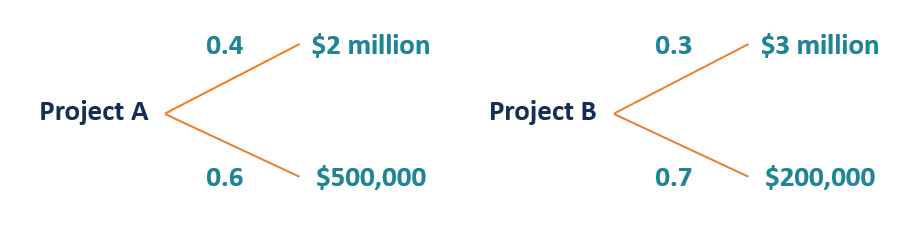
In order to select the right project, you need to calculate the expected value of each project and compare the values with each other. The EV can be calculated in the following way:
EV (Project A) = [0.4 × $2,000,000] + [0.6 × $500,000] = $1,100,000
EV (Project B) = [0.3 × $3,000,000] + [0.7 × $200,000] = $1,040,000
The EV of Project A is greater than the EV of Project B. Therefore, your company should select Project A.
Note that the example above is an oversimplified one. A real-life example will likely assess the Net Present Value (NPV) Net Present Value (NPV) Net Present Value (NPV) is the value of all future cash flows (positive and negative) over the entire life of an investment discounted to the present. of the projects instead of their EV. However, NPV calculations also consider the EV of different projects.
More Resources
CFI is the official provider of the Financial Modeling and Valuation Analyst (FMVA)™ Become a Certified Financial Modeling & Valuation Analyst (FMVA)® CFI's Financial Modeling and Valuation Analyst (FMVA)® certification will help you gain the confidence you need in your finance career. Enroll today! certification program, designed to transform anyone into a world-class financial analyst.
To keep learning and developing your knowledge of financial analysis, we highly recommend the additional CFI resources below:
- Dependent Variable Dependent Variable A dependent variable is a variable whose value will change depending on the value of another variable, called the independent variable.
- Independent Variable Independent Variable An independent variable is an input, assumption, or driver that is changed in order to assess its impact on a dependent variable (the outcome).
- Regression Analysis Regression Analysis Regression analysis is a set of statistical methods used to estimate relationships between a dependent variable and one or more independent variables.
- Zero Sum (and Non-Zero) Game Zero Sum Game (and Non Zero Sum) A zero sum game is a situation where losses incurred by a player in a transaction result in an equal increase in gains of the opposing player
Mathematical Expected Value Worksheet Answer Key
Source: https://corporatefinanceinstitute.com/resources/knowledge/other/expected-value/
Posted by: cervantezarrierld.blogspot.com
0 Response to "Mathematical Expected Value Worksheet Answer Key"
Post a Comment